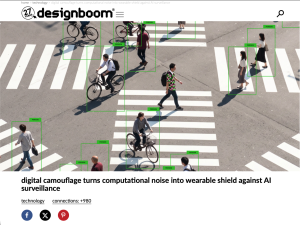
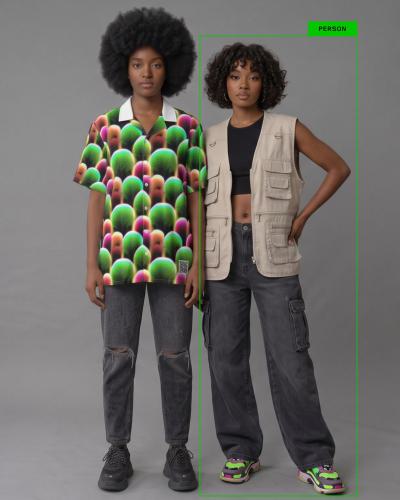
A garment whose hypnotic pattern tricks the computer-vision systems watching public space.
The City That Reads You
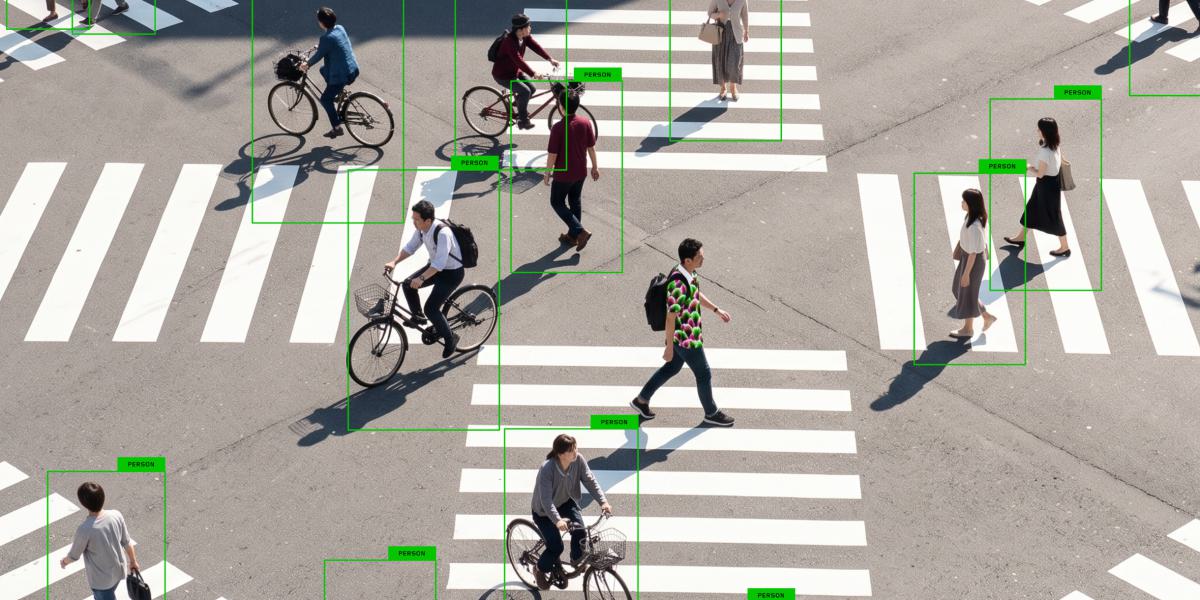
In Berlin, what is being switched on is more than a camera. It is a behaviour scanner: software that sorts what every passer-by does into "normal" and "suspicious"—the first camera legally allowed to film the city's public space without any specific cause. To isolate a punch, the system has to classify dancing, hugging and countless other harmless gestures too; everyone is read, all the time, under a quiet reversal of the presumption of innocence. Kottbusser Tor is only the template: three more locations are next. And Berlin is the beginning of a curve whose end is already visible elsewhere. In the United States, automated surveillance arrived years ago: well over a hundred thousand networked cameras log vehicles and movements across thousands of towns, their data searchable by police and federal agencies without a warrant. But 2026 has become the year of the pushback: dozens of communities have voted to cancel their camera contracts, and the question of who is allowed to read the public street has entered the mainstream. Meanwhile, decades of research suggest cameras rarely prevent crime—they displace it, or produce a feeling of safety rather than safety itself.
Invisible to the Machine
The pattern of Digital Camouflage is built on an adversarial attack: a way of manipulating the visual data a machine receives so that it fails to interpret what is in front of it. Worn on the body, it targets exactly the features these systems look for when searching for a human figure. The algorithm no longer registers a person. The wearer becomes, in effect, invisible to the machine—present to every human eye, absent to the model. Whether any specific government system reacts the same way, no one outside can verify—and that opacity is part of what the work makes visible: cities are deploying systems that cannot be independently tested, while the same class of technology is undone by a piece of fabric. The work was documented on site at Kottbusser Tor, in photo and video. Digital Camouflage is not a tool for evading the police, and not a promise of anonymity. But worn in public, it is a visible signal that being read by machines is not something everyone consents to. When untestable systems can be defeated by fabric, how much trust should we place in them before we hand them the public square? A share of the proceeds goes to organizations defending digital civil rights.
Where to find us at DDW
You can meet us in person and test the shirt physically at the Schellens Fabriek, where we will be part of the something.bigger exhibition. In addition to our main presence there, pieces of our work will also be on display at two other locations: Sectie-C and Potenhuis. Stop by to see the adversarial fabric up close and join the conversation about privacy, technology, and the future of our public spaces!
About Simon Weckert